Showing posts with label Media. Show all posts

Sunday, 15 November 2015

FIRST TEST PROTEST SCRATCH FILM


This is the first attempt of what I'd like to project onto my protest art inspired garments. I first made some recreated posters, which I then scanned into the computer, cropped and turned them into a GIF file. It is alright for a first attempt but I would like to improve it by firstly making more posters, about different protest movements, and also by speeding up the GIF, so it is more like a scratch film. Hopefully the finalised video will be fast enough so only certain words are clear enough to stand out. I will then project this video onto garments and models.

Thursday, 15 October 2015

MUSIC PERFORMANCE FILMING

I spent an afternoon observing the media pathway filming another student's musical performance. As well as the musician, there was a floor manager, and three people controlling cameras downstairs. Everyone else was upstairs, there was someone on sound recording and another controlling which camera shot would be used in the main video, and fading from one shot to another. The tutor was directing the filming, by giving orders and communicating to students through a microphone and headsets.

Wednesday, 14 October 2015

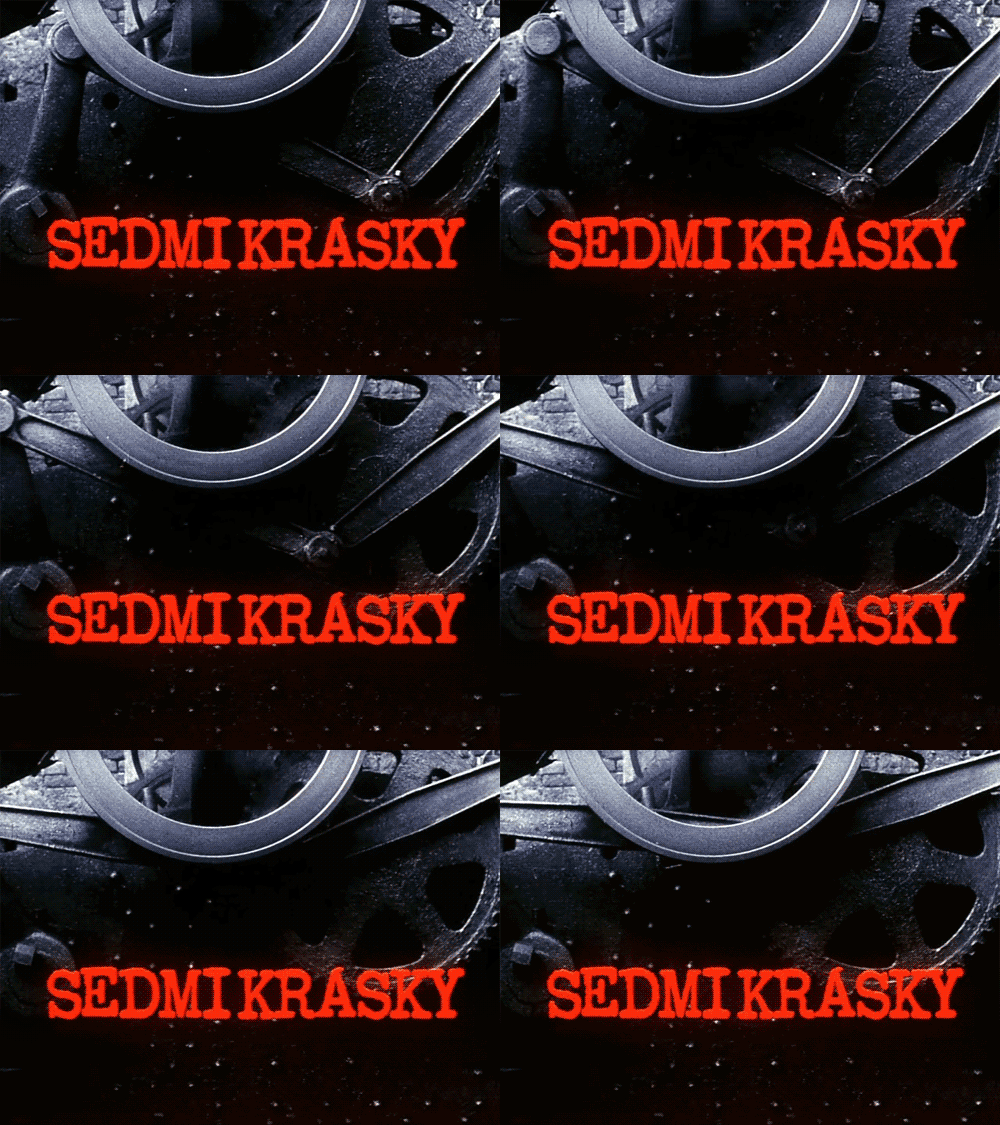
SEDMIKRÁSKY / DAISIES

Sedmikrásky (Daisies) is a film made in Czechoslovakia in 1966 and directed by Věra Chytilová.

It was made amidst an era of social change and released two years before the Prague Spring. Around the developed world, there were shifts in power, as groups revolted against their respective leaders; student riots in Paris (1968) followed by a general strike of over 10 million workers brought the country to a standstill and threatened to wholly overthrow the government. Similarly, there were student demonstrations in the UK and US, however as they were confined to single areas, they were smaller scale to those in Paris. 

The culture of revolt and protest was rife at this time, student protests joined with anti-war and peace protests (especially anti-Vietnam throughout the 1960-70s). Governments were made aware of any discord. 

Czechoslovakia was going through cultural reform at this time. "In the summer of 1968, the focus of student radicalism shifted to America, where students expressed their disillusionment with the capitalist democracy and Czechoslovakia, where they sought to embrace it. In August, young people assembled in the streets of Prague to

protest against the crushing of the Velvet Revolution (an attempt to introduce some democracy in this communist country) by the USSR" - ('A Sixties Social Revolution?: British Society 1959 - 1975' - Sally Waller).

Carmen Gray (BFI) on Chytilová; "(she) formed her career when Czechoslovakia was under Soviet rule, and the politically charged climate deeply impacted her work. She was accepted into Prague’s renowned film school FAMU, which brought her together with other directing talents such as Jiří Menzel and Jan Němec. They made films with a spirit of dissent and black humour that satirised life under the communist regime, and collectively became known as the Czech New Wave. This flourishing of creative expression was part of a period of liberalisation that culminated in the 1968 Prague Spring – Alexander Dubček’s attempt to bring “socialism with a human face”. It didn’t last long. Soviet-led tanks rolled in to crush the reforms, bringing a cultural crackdown. A number of Chytilová’s contemporaries left for abroad, but she continued the struggle to work at home. The state-controlled nature of film funding meant falling foul of the authorities left few alternatives to get projects off the ground, and in creative frustration Chytilová at times resorted to working on TV commercials under a pseudonym.

In 1966, Chytilová made her second feature Daisies – a playful riot of mischief and joyous, kinetic experimentation. Its giggling accomplices Marie I and Marie II agree that since the world has gone bad they’ll be bad too. Their pranks wreak havoc around Prague, as they leave the sugar daddies who dine them abandoned with huge bills, and scandalise a dance hall with their beer-stealing antics. The mayhem culminates in a debauched food fight, as the friends lay waste to a banquet that’s been set out for party officials, and swing from a giant chandelier. This irreverent carnival of excess and destruction was the antithesis of state ideology glorifying worker productivity and promising a bright utopian future for heroes of developed political consciousness. The authorities banned Daisies, citing the wastage of food as particularly reprehensible. An end-title dedicated the film “to all those whose sole source of indignation is a trampled-on trifle” – a barb aimed at hypocritical officials who would take offence at such scenes, while turning a blind eye to greater evils. 

The playful, anything-goes experimentation of Daisies, with its psychedelic onslaught of coloured filters and fragmented editing, made it the most formally vibrant and daring film of the Czech New Wave. Made up of absurdist, surreal episodes, these films drew on nature for their floods of striking imagery and abstracting patterns, and featured some of cinema’s most startling opening sequences. In Daisies, black-and-white archival imagery of warplanes strafing the ground sets the scene for a world ripped out of joint.".

Chytilová had a strict Catholic upbringing which influenced her film-making. '"I left that basic, personified faith," she later said. "It seemed like a crutch to me. I realised it wasn't true – but those moral codes are inside me." In fact, most of her films could be described as morality comedies' - Ronald Bergan (The Guardian).

There are different interpretations of Sedmikrásky; some people believe is it one of the great works of feminist cinema, whilst others stand that it is comment on the danger of consumerism within society - 'a socialistic warning bell against consumerism invoked inside a greedy, superfluous capitalistic system which revolves around luxurious pretensions?' (Janus Films). The two protagonists; Marie I and Marie II, give off a wholly care-free attitude. All the male characters in the film are simply there for the women's enjoyment; part of their pranks before being cast away. This reversal of the traditional role of the genders was particularly interesting within the film, but considering the final scene and comment at the end of the film; “to all those whose sole source of indignation is a trampled-on trifle”, I believe Chytilová made this film to tactfully show her stance on consumerism and the changing attitude towards it.

I really liked the film. Having watched it before, my second viewing of it could be spent picking out visual effects and particular scenes rather than focusing on the plot or context. I particularly liked;


The scene where Marie II cuts a hole in some plain bed linen and continues to rip it revealing a floral pattered quilt.

The framing of the first lunch scene, as there are three sat at the table, the angle of the camera makes the viewer feel as if they take up the forth place at the table. Also the costume of Marie I; the quintessentially 1960s shift dress with the scarf combined with her childish hair style in two ponytails plays up to  her absurd character.

The use of space and framing of the shot in the bar scene, where the two Maries drunkenly cause havoc at their own and the surrounding tables.

The change to black and white filming whenever they abandon male characters on trains at the station. Especially the close up shot of one of the men crying and waving goodbye from a train window, and the total nonchalance of the women as they leave him.

I found the scene in the bathroom, where the two Maries encounter the woman they refer to as an 'angel', very interesting as although it is made clear their feelings towards all of the male characters, their reaction to another woman is very different, almost adoration.

The scene where the two Maries are hiding in a crop field, which is in colour, I felt, as the viewer, that they stood out very clearly from the natural colours of the crops. The use of simple and natural crops contrasts the very decadent food used in the rest of the film.

The use of colour in the following scene, where Marie I wears a blue dress infront of a green door, and Marie II has the opposite.

I loved the bizarre scene where the two women have an argument and begin cutting up one another, and their floating heads appear disconnected to their bodies.

The eventual scene where the women come across a banquet and destroy most of the food, use the table as a runway and swing from the chandelier.


Other than the quality of the image, the content of this film is so absurd that it would be difficult to place when it might have been made. I agree with my lecturer that it doesn't look 50 years old, when it is compared to films released in the same year (1966), such as 'Alfie', 'Whose afraid of Viginia Woolf?' and 'The good, the bad and the ugly', you wouldn't imagine 'Daisies' was made at a similar time. This may however, be because the film itself was very contemporary, perhaps even ahead of it's time with the subjects it covers, since it was deemed unseemly and banned on release.

Wednesday, 7 October 2015

NEVER LET ME GO

'Never let me go' was released in 2010, and is a film directed by Mark Romanek. It is based on a novel written by Kasuo Ishiguru in 2005.

The film focuses on the protagonist; Kathy H and is set over a 16 years. It is split into three time periods, the school (1978), the cottages (1985) and her time as a carer (1994). However without these given dates, the film is more difficult to place. The protagonists look more at home had the film been set in the 1950s, sheltered from and oblivious to the time they are truly living in. This is one of the first indications that there is a darker side to the plot. That there are more things they are ignorant about.


One of the more interesting things about this film was, although it's plot line would naturally lend itself to the sci-fi genre, it's dreamy cinematography and the characters final melancholic acceptance of the 'system', make it very different from others in the sci-fi category.

Unlike other science-fiction stories, the 'twist' in the tale isn't a major part of the plot, it is an inevitable fact of the characters lives - "If information does trickle gradually it's because the children themselves do not realise who they are. The reader is on a sort of parallel journey, but it is not a mystery story. My focus is elsewhere". Peter Bradshaw (The Guardian) on 'Never let me go' - "The secret purpose which the government have assigned to them is not revealed with the flash of drama, horror, or vertigo that it might have in conventional sci-fi treatments. In storytelling terms, this is a bit disconcerting. But the very point is perhaps that it is humdrum, workaday, embedded in the tatty fabric of everyday life, and just something else to be depressed about. The secret – hidden in plain sight – is mysterious, horrifying and yet accepted: it is like death itself, that drab fact in all our lives which is just as mysterious and horrifying, and yet treated by all of us, every day, with a fatalistic, unthinking shrug. Despite the heavy weather, Never Let Me Go never delivers a cloudburst of emotion or revelation, and yet it has ideas; it resists categorisation, and it lingers in the mind".

The author (about the sci-fi classification), says he is more interested in "How are they trying to find their place in the world and make sense of their lives? To what extent can they transcend their fate? As time starts to run out, what are the things that really matter? Most of the things that concern them concern us all, but with them it is concertinaed into this relatively short period of time. These are things that really interest me and, having come to the realisation that I probably have limited opportunities to explore these things, that's what I want to concentrate on."

I believe the themes of isolation mirror the authors life in some ways, his families heritage and the way his parents continued to consider themselves temporary British citizens, must have given Ishiguru mixed feelings about his own affinity to the UK. Ishiguru's sometimes isolated upbringing often materializes in his writing. Although living in England for most of his life, he was born in Nagasaki, "Nagasaki is not just a few hazy images. I remember it as a real chunk of my life". His parents never intended to stay indefinitely, and 'didn't have the mentality of immigrants because they always thought they would go home at some stage'. At 15 it was decided that the family would stay in the UK. Continuing to consider themselves Japanese, his parents still find it interesting to discuss 'the English'. Being the only "non-white kid" in his school, Ishiguru was often given nicknames - 'Tony Beagley, a friend then and now, says although it sounds shocking "I really don't think those names were meant nastily. He was just the unusual bloke in the school and I can't recall any bullying or him getting a hard time because he was Japanese"'.

Ishiguru took his citizenship very seriously, he wasn't a British citizen well into his writing career, "I couldn't speak Japanese very well, passport regulations were changing, I felt British and my future was in Britain. And it would also make me eligible for literary awards. But I still think I'm regarded as one of their own in Japan."

I particularly liked some of the more photographic scenes in the film. There were shots which were framed in a way which might lend them to photographs but had something simple moving in them, such as the scene with the ball in the grass, or the map in the classroom gently blowing in the wind. After further research I found an artist who creates a similar effect - here.

I also liked the idea of democratic art; that there is no high or low value art. All art is important and, although can be judged against and compared to other art, it doesn't fundamentally make it worth any less. I think the film and story can be considered a microcosm for the 1st / 3rd world divide. More developed societies are aware of the awful conditions going on in poorer parts of the world, through media and education, however people choose to ignore or breeze over the uncomfortable facts. In this way, the dystopian society in the story have become so accustomed to improved health through organ donation of human clones, to the extent that although it is clear, these clones are no different from 'normal' humans, they would refuse to return to an age of regression, so choose to ignore the immoral nature of the system. It also echos other justified immoral acts which have taken place throughout history; various groups have been dehumanised by the majority by means of establishing rules. The clones in the story were made to give their lives for other equal beings, because they were scientifically classified as something else.

Tuesday, 6 October 2015

MEDIA ROUNDABOUT: CONFESSION VIDEO

This was a collaborative task. Each person on the foundation course was involved in some way or another, whether it was providing the content, by speaking on the film, or working the camera or set directing.

There were four roles in this task, which everyone rotated around in the group to try each one. There was the director, camera operator, speaker and personal who covered the speaker's eyes. The director managed the set, and called for the camera operator to start and stop filming. The person controlling the camera had to frame the picture, and direct the person covering the speaker's eyes, to make sure the face could still be seen but the eyes couldn't. The speaker had to provide appropriate and honest content for the piece.

This piece was a homage to Gillian Wearing's 'Confess All On Video. Don’t Worry You Will Be in Disguise. Intrigued? Call Gillian' (1994). This idea behind the piece was to create a safe space where people could make a confession, the twist was to establish a sort of anonymity so although the confession was made, individuals were still protected from what they had done. Rather than physically disguise the speakers like Wearing's original piece, we simply hid the eyes of the speaker.


Because of the personal nature of the work, our tutor made three rules; first, that all confessions made must in fact be true. Second that we would all be given time to think of an appropriate confession to use, and lastly that no one would be mocked or ridiculed in anyway for what they had to say whilst being filmed, that it was a safe space.

The studio had a stool for the speaker to sit on in front of a blackout curtain, this worked to create the illusion of an infinite space behind the speaker, and also kept your focus on what they were saying. Before each speaker began, the studio lights and sound levels had to be checked. To do this the speaker had to attach a microphone to their clothing and speak for a while, sound levels had to be adjusted so people were speaking at the same volume on the final video. Getting the speaker to talk before hand, also worked to make them more comfortable when they were making their confession.


Tuesday, 8 September 2015

SCRATCH FILM

The whole foundation course was positioned around tables in a long line, with a strip of film rolled out following the line.

Each person was assigned the 1 metre strip of film in front of them (which would equate to about 2.5 seconds of film). We were instructed to work directly onto the film, with permanent markers. We couldn't damage the film or stick anything onto it, otherwise it wouldn't be able to go through the projector.

As it was a collaborative project, we were told to note what the people working next to you were doing, so we could decide whether or not to make our strip of film link in with theirs or not. Different people worked in different ways; some attempted text, specific drawings / images and others created abstract patterns. I decided to limit my section to one colour (blue), because the people working on either side of me had opted for multiple colours, and I hoped this would make the three sections more distinct within the piece as a whole. However I tried to imitate a circle shape in my section as this linked to the person on my left.

The collaborative work amounted to around 6.5 minutes of film (full film here). I like how different people's contributions stand out within the film, but that it is still effective as a complete piece. We experimented with how music effected the tone and meaning of the piece when we watched it together. In the first viewing, it was silent, other than the sound of the projector, this tied the piece to the intended purpose of the medium. However on second viewing, music was added, it was decided that the music made the transitions between people's sections more fluid and gave the piece rhythm.


SCRATCH FILM RESEARCH

We were shown a couple of example films; Len Lye's 'Kaleidoscope' (1935) and Stan Brakhage's 'Mothlight' (1963).


These works are an example of artists changing the potential of a medium. They have completely deviated from the intended purpose of 16mm film, by working directly onto it, and in the case of Brakhage, pressing his subject between two pieces of film before contact printing it.

Lye's use of colour and pattern in 'Kaleidoscope' makes it difficult to immediately pinpoint when it was made. If the original audio (Don Barreto and his Cuban Orchestra) was replaced, the film could easily be assumed to be from another era. Considering the social climate at the time of its completion; the global depression of the 1930s, this bright and cheery film seems out of place, the only telltale time-placing feature is the product placement for Churchmen Cigarettes (Lye animated stencilled cigarette shapes onto the film), who sponsored Lye to make the film in 1935.

Stan Brakhage's 'Mothlight' contrasts Lye's lighthearted advertising campaign. His colour palette is dictated by, and limited to, the neutral tones from the natural materials he collected (moth wings, flower petals and blades of grass). The tone of the piece remains melancholic with just the sound of the projector on the recording. Where Lye's 'Kaleidoscope' appears psychedelic, the mixture of abstract shapes and perfectly formed wings in 'Mothlight' create a sombre dreamlike film, which perfectly mirrors the atmosphere you imagine Brakhage to be working in, when you learn about his living situation during the making of the film.

These scratch films reminded me of Carine Khalife's animation 'Blown Minded', which creates a similar dreamlike effect to 'Kaleidoscope' and 'Mothlight', despite being oil paintings on glass rather than film. Her larger medium (sheets of glass rather than 16mm                          film), allows her subjects to be both abstract whilst being more
narrative. The purpose and tone of the piece changed as her films were used as music videos for the band Young Galaxy.

The audio accompanying films has a massive impact on the tone of the overall piece. For example, the combination of fast moving

bright colours and shapes with a cheery upbeat song in Len Lye's 'Kaleidoscope', makes the piece ideal for advertising. Whereas Brakhage's 'Mothlight', which doesn't have additional audio, appears more serious. The lack of music and the chosen medium (moth wings and natural materials), makes the slide transition more obvious to the viewer, meaning the piece appears more methodical and almost scientific, whereas the music and fluid animation in 'Kaleidoscope' and 'Blown Minded' give the pieces rhythm.


Images and GIFs sources;
(http://indiemusicfilter.com/video-blown-minded-by-young-galaxy, http:// rebloggy.com/Carine+ McCandless/search/bestmatch/page/, http://www. artmattermagazine.com/not-watching-eurovision-neither-are-we-heres/, http://gifmovie.tumblr. com/page/574, http://hcl.harvard.edu/hfa/films/ 2007novedec/lye.html, http://criterionreflectio ns.blogspot.co.uk/2013/07/mothlight-1963-184.ht)